Think about your morning.
You woke up. You reached for your phone (or maybe you didn’t, and that’s a process decision too). You made coffee. You got dressed. You drove, walked, or commuted to wherever you needed to be.
None of that felt like a “process.” It just felt like…life.
But here’s the thing: every single one of those actions follows a sequence. Inputs go in, steps happen, an output comes out. Your morning routine is a process. Your weekly meal prep is a process. The way you answer emails, the way you plan a vacation, the way you unwind after a long day, these are all processes.
And that realization is quietly one of the most powerful things you can have.
Why Most People Never See It
We don’t think of our daily lives in terms of processes because nobody taught us to. We reserve that word for factories, flowcharts, and corporate boardrooms. “Process improvement” sounds like something that belongs in a manufacturing plant, not in your kitchen or your calendar.
But Lean Six Sigma, the discipline I’ve spent years working in, was never just about manufacturing. At its core, it’s about one deceptively simple idea: observe what’s actually happening, then make it better.
That applies everywhere.
The problem is that most people operate on autopilot. They repeat the same routines, tolerate the same friction, and accept the same frustrations without ever pausing to ask a basic question:
Why does this feel harder than it should?
The Invisible Tax of Unexamined Routines
Let me give you a small example.
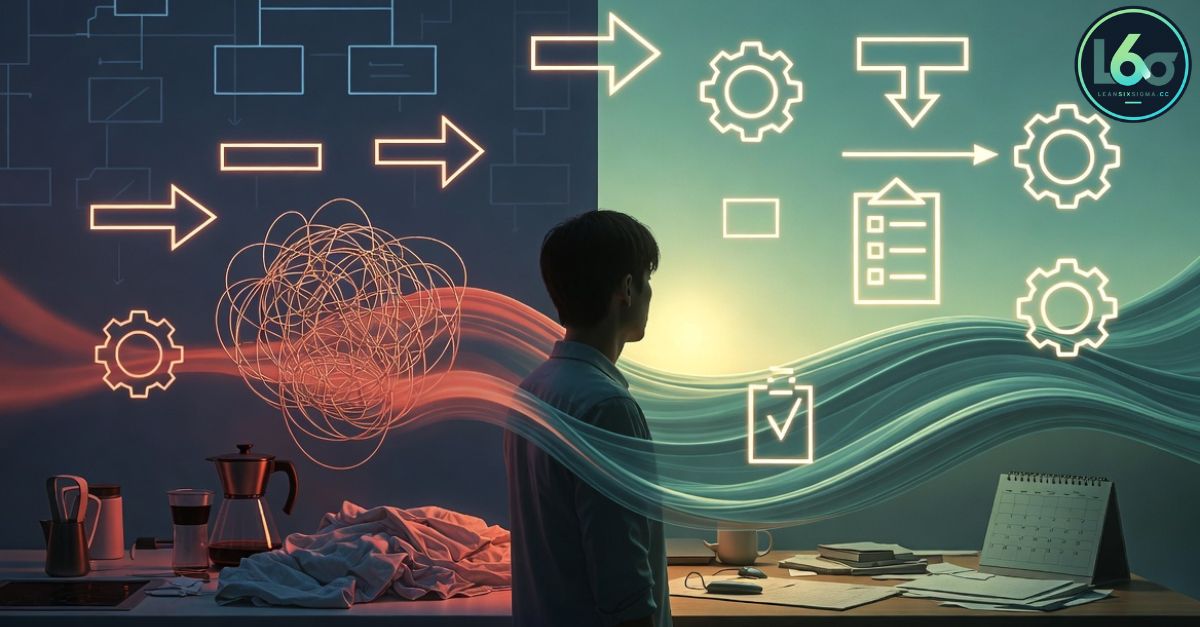
A friend of mine used to spend about 20 minutes every morning deciding what to wear. Not because he had a complicated dress code, most of the time he worked from home. It was because his closet was disorganized, his laundry cycle was unpredictable, and he never actually thought about what “getting dressed” looked like as a sequence of steps.
Twenty minutes. Every day. That’s over 120 hours a year spent standing in front of a closet feeling frustrated.
After telling him bluntly,he finally mapped it out, literally wrote down the steps, then he spotted the waste immediately. Clothes he never wore taking up prime real estate. A laundry schedule that created bottlenecks mid-week. Decision fatigue from too many nearly identical options.
He didn’t need a Six Sigma Black Belt to fix it. He just needed to see it.
Within a week, he’d cut that time down to five minutes. He got back over 90 hours a year. Not from some productivity hack or app. From looking at a process he’d been running on autopilot for a decade.
Three Questions That Change Everything
In Lean Six Sigma, we have sophisticated tools – DMAIC frameworks, control charts, statistical analyses. But before any of that, there’s something far more fundamental.
There are three questions you can ask about anything in your life:
What feels slow?
This is your cycle time problem. Where are you spending more time than the outcome justifies? Long commutes, drawn-out meetings, repetitive manual tasks, these are all signals that a process has unnecessary steps, bottlenecks, or delays baked in.
What feels repetitive?
This is waste. In Lean, we call it muda. If you’re doing the same thing over and over without adding value, re-explaining something that should be documented, searching for items that should have a designated place, making the same decision you already made yesterday, you’ve found waste. And waste is always an opportunity.
What feels frustrating?
This is the gold mine. Frustration is an emotional signal that something in the system isn’t working. Maybe it’s a handoff between two people that always causes confusion. Maybe it’s a tool that almost does what you need but not quite. Maybe it’s a recurring problem that everyone works around but nobody fixes.
Frustration isn’t something to push through. It’s data.
You Don’t Need a Certification to Start
I want to be clear about something: you don’t need to be a Lean Six Sigma practitioner to benefit from this mindset. You don’t need a Yellow Belt, Green Belt, or Black Belt to look at your daily routines with fresh eyes.
All you need is the willingness to pause and observe.
Here’s a challenge for this week. Pick one thing in your life that consistently bugs you. It could be at work, a report that takes too long, a meeting that never produces action items. It could be at home, a cluttered space, a meal-planning process that falls apart by Wednesday.
Now, instead of just pushing through it again, try this:
- Write down the steps. Not what you think the steps should be. What actually happens, in order, including the detours and the workarounds.
- Mark what adds value. Which steps actually move you toward the outcome you want? Be honest. Some steps exist only because they’ve always been there.
- Identify one thing to change. Not ten things. One. The smallest adjustment that could reduce the time, effort, or frustration involved.
- Try it for a week. See what happens. Adjust. Repeat.
That’s it. That’s process improvement. No jargon, no certifications, no complicated tools. Just the discipline of paying attention and the courage to change what isn’t working.
The Compound Effect of Small Improvements
Here’s what happens when you start seeing processes: you can’t stop. (I know I can’t)
You’ll notice that your email workflow has three unnecessary steps. You’ll realize your team meeting could accomplish the same thing in half the time with a different agenda structure. You’ll see that the friction in your morning isn’t about discipline, it’s about design.
And each small improvement compounds. A five-minute savings here, a frustration eliminated there. Over weeks and months, these micro-improvements reshape your days in ways that feel disproportionately significant.
In the Lean world, we call this kaizen, continuous improvement. Not dramatic overhauls, but a steady, relentless commitment to making things a little better, a little smoother, a little more intentional.
It’s not glamorous. It rarely makes for a viral post. But it is, without exaggeration, one of the most reliable ways to create a life that actually works the way you want it to.
The Real Insight
Everything in your life is a process.
That’s not a limitation. It’s a liberation.
Because if something is a process, it can be observed. If it can be observed, it can be understood. And if it can be understood, it can be improved.
You just have to be willing to look.
What’s one process in your life that you’ve been running on autopilot? Drop it in the comments – I’d love to hear what you notice when you stop to look at it.
